

One thing we know is that there will always be Google spam update, even when Semrush’s volatility tracker is flashing a blistering 9.4/10. But this rollout coincides with a viral research paper from Google about the “synthetic gap” and especially highlights that Google has rolled out a new detector called “Scaled Abuse Forensics Examiner (SAFE) designed to expressly identify scaled content abuse.
As a marketer or SEO specialist managing AI-assisted content workflows, you are right to worry that these spam updates can impact your site, no matter how painstakingly you prepare.
Google’s September 2026 spam update is the fourth this year. So you can rightly say Google is super serious about AI-generated spam. If you’re rolling out AI-assisted content workflows, guessing at your exposure is expensive because a hit site can stay downgraded for several months before Google’s systems confirm it’s compliant again. That’s why I created a Google spam update content audit framework. You can grab the framework in a checklist version here.
How do you create content for your brand?
Right now, some of us are letting AI draft articles and then asking humans to tidy them up.
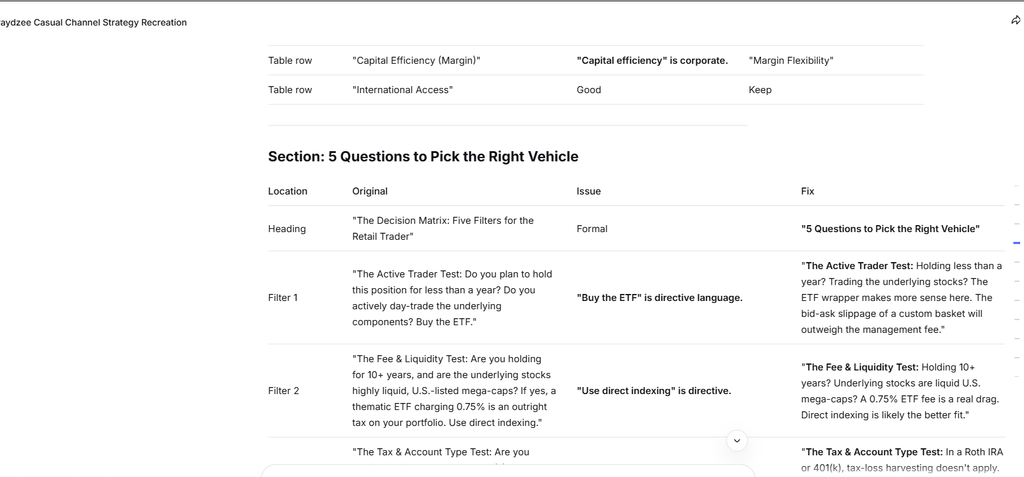
I do the reverse. I write the first draft myself based on my research, including the POV I want to take. Then I give AI one job: tear it apart. Find every claim I can’t support, every place I drifted from the brief, every sentence a skeptical reader would push back on. As the product and content marketing manager, I’m the one answerable when a claim goes out under a brand’s name, and I’d rather the harshest reader see it before a customer does.
Here’s an example of what that looks like.
After writing an article for a financial platform, I edited and found a line that told readers to “buy the ETF” if they planned to hold a position for under a year. In a regulated space, that reads as advice. So, I fixed it with a more conditional line: if you’re holding for less than a year and trading the underlying stocks, the ETF wrapper makes more sense, because bid-ask costs on a custom basket can outweigh the management fee.
It’s still the same idea, but now the reader holds the decision.
AI-generated drafts fail regardless of detailed prompts
AI is a poor author for the same reason it’s a good adversary. It produces the plausible average of everything already published. So, if you used an AI research-and-drafting workflow and only had a human edit at the end, there’s a good chance it’s still a rehash of what’s already out there. This is exactly what Google spam policies catch at scale. By contrast, using AI as an adversary creates a tireless, ego-free editing system that serves as an excellent critic.
Spam updates punish both pages and operations
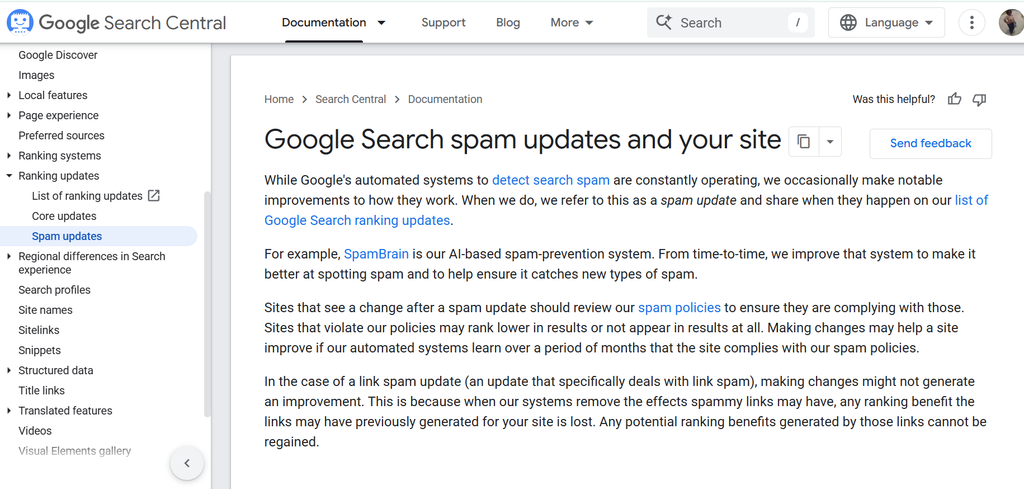
We often think that spam updates are just about penalizing content created with AI. But when you read the full details of these updates, you realize they target scaled content abuse, which means producing many pages mainly to rank, however they’re made. That covers automation, humans (content mills), or a mix of both. And so the whole story of AI content and Google spam policy is the scale and the lack of value.
Depending on the scale and resources, I’ve seen teams at the very least rely on AI detectors because they don’t want their freelance writers submitting AI-generated drafts. But then passing Copyscape or an AI detector isn’t a spam-update strategy. Those tools only tell you whether the article reads like robotic machine-generated text; they won’t tell you whether the page is actually useful. If you aren’t well-versed in the topic or a true subject-matter expert, it’s incredibly hard to tell whether the intended reader will find the piece valuable.
In my own client work, human-written drafts rarely come back flagged by these AI detectors.
But again, that doesn’t dictate whether a page deserves to rank. An entirely human-written page can still be painfully thin.
Google’s viral paper on Scalable Detection of Adversarial Synthetic Slop explicitly outlines a shift away from analyzing individual pages in isolation. They have deployed infrastructure such as the Scalable Cluster Termination System (S-CTS) to address publishers’ operational patterns.
The real exposure sits upstream: how fast you publish, who checks what, and whether anyone can trace a claim back to a source. That’s why this content audit checklist covers your entire operation.
(Note: It’s important to distinguish between Google spam updates and core updates. A spam update enforces specific policies, while a core update re-evaluates quality across the web. Which one hits you dictates whether you need to fix violations or improve overall site quality).
The Google Spam Update Content Audit Checklist: 12 Checks
| # | Check | Ask yourself | Guards against |
|---|---|---|---|
| Strategy | |||
| 1 | Customer problem first | Does each topic map to a real customer problem, or only to a keyword? | Keyword-first filler |
| 2 | Added value | What does this page say that the top-ranking pages don’t? | Rewritten competitor content |
| 3 | Pace vs. review capacity | Can your reviewers properly check everything you publish each week? | Scaled low-value content |
| Production | |||
| 4 | Standalone answer | Is the answer in the first 100 words, and does it survive being quoted out of context? | Vague, padded pages |
| 5 | Source trace | Can you open the source for every stat, quote, and test result? | Invented claims |
| 6 | Experience labeling | Is first-hand experience marked as such, and are untested claims attributed? | Fake authority |
| 7 | Specificity sweep | Are weasel words and generic headers cut? | Interchangeable copy |
| 8 | Voice match | Do new pieces match your 3–5 best ones? | Template sameness across writers |
| 9 | Stated limits | Does every method say when it fails? | Overclaiming |
| Operations | |||
| 10 | Independent fact-check | Does someone other than the writer verify facts? | Errors editing passes miss |
| 11 | Claims review timing | Does compliance or claims review happen before drafting? | Risky claims creeping back in |
| 12 | Refresh and prune log | Is every page dated, owned, and reviewed, and are thin ones cut? | Decaying archives |
As a rough guide (my own bands, not Google’s): 0–8 means rebuild the process, 9–16 means you’re patchy, and 17–24 means you’re solid. The weakest layer matters more than the total.
Four uncomfortable truths to remember
- Your copy-editor is not your fact-checker. At the very least, your editor might catch issues with grammar, flow, and clarity. But that’s not enough. A wrong stat with clean grammar will go through. And that’s how errors get published confidently. You need your content fact-checking process to be more comprehensive.
- Publish less. Your review capacity should cap your cadence. If you can properly verify five pieces a week and you publish fifteen, ten are unchecked, and an unchecked archive is what a spam update tends to expose.
- Fast solo ownership is a single point of failure. In past projects, I owned the messaging, compliance thinking, and writing. That’s efficient, and it works because I know the brand cold. But it’s a risk most teams shouldn’t copy. You shouldn’t have just one person positioned to challenge them.
- The audit isn’t everything. I’ve built this risk reduction process from real editorial practice. But in your own case, it’s going to go deeper depending on your industry. That said, it’s going to provide a good starting point.
How to run a content quality audit for SEO this week
- Pull your 10 most recent pages.
- Score all 12 checks for each. (Grab the free Content Spam Update Audit – 12 Checks Google Sheet here).
- Find your weakest layer: strategy, production, or operations.
- Fix the cheapest gap first. For most teams that’s check 10, because a second set of eyes on facts costs far less than a recovery.
Is your content engine built to scale or built to break?
If you’d like me to run this audit on your content operation, or build articles designed to hold up, book a call. It works whether you need to recover from a Google spam update or want to proof your strategy before the next one lands. Send an email at chidera@chiderastudio.com, or book a call here.