

As a founder who has either just secured funding for your startup or is trying to, you worry about getting more customers. You may already be getting some demo calls, but you equally notice that conversion is slow, and you can’t figure out why buyers who seem engaged disappear.
I’ve realized from working with B2B SaaS founders that the problem isn’t usually your product but how you sell it.
Specifically, in this case, the B2B product demo experience and the messaging leading up to it aren’t addressing what your buyers are actually afraid of.
It’s no wonder that many B2B buyers say that the product demos they receive feel generic. Gartner even reports that 73% of these buyers actively avoid vendors that send irrelevant and poorly targeted assets.
So, your buyers worry that if you don’t understand their unique problems, how can they trust you with their patients’ needs?
What most B2B SaaS marketing strategies get wrong?
To effectively market your B2B saas, you need to stop thinking in terms of what your product does and what your buyers fear. Thinking in terms of their specific workflow, risk profiles and regulatory issues. They don’t want feature walkthroughs, platform capabilities or other forms of “let me show you what we can do” – not yet.
If that’s all you’re saying, you sound like everyone else.
“If your marketing gets the response ‘great demo’ but no commitment, it has failed. The goal isn’t to impress but to make the buyer feel safe choosing you.
Your buyers, whether they are executives, directors, or procurement leads, don’t want you to impress them. They are shopping for solutions that would reduce risk. Every question they are asking underneath the surface sounds something like this:
- Will this create compliance or regulatory exposure I’ll have to answer to?
- Am I risking an audit by implementing this tool?
- Will my staff actually use this, or will it sit there unused like the last three platforms we bought?
- If this goes wrong, would it cost me my job or, worse, affect patient outcomes?
- Am I spending hundreds of thousands of company dollars on a solution that won’t survive the next budget cycle?
That’s why your B2B SaaS pipeline stalls. You’re not answering the hidden objections.
Think in nightmares to define your product demo
Put all those questions together alongside respective pressures. For example, in the UK, healthcare decision makers are also dealing with staffing shortages in the NHS. In the US, there’s reimbursement pressure and documentation burdens.
Let’s take a detour to the biotech scene. Here, your buyers love the science and milestones you’ve gone through. But it won’t push them to convert. It’s much better to focus on overcoming their uncertainties about funding, execution, and reputation.
When your demo isn’t reflecting all of these issues that keep them up at night, you’ll stay invisible even in these fast-growing markets.
And no — “reducing documentation time” and “cutting errors” don’t count. Every AI-powered product in your category is saying that. You need to go one level deeper into the specific risk your buyer is carrying.
Focus on your buyers
Vibe coding, AI-assisted workflows, interoperability standards (like FHIR) and cloud-native infrastructures have created a crowded market of other solutions like yours.
Your buyers are also more informed and skeptical.
They’ve seen dozens of “AI-powered” promises that underdelivered.
Organizations are also under pressure to adopt connected-care models. But they are still wary of privacy issues, bias, or workflow disruptions. These are the things you should talk about that they would respond to.
Think in terms of outcome-focused storytelling.
What’s the one thing they can look forward to when they use your product?
Build your demo around a real life scenario that mirrors it. If you’re selling to NHS Trusts, your demo should feel like it was built for NHS Trusts — not adapted from a US healthcare template. If you’re selling to a community health clinic versus an academic medical centre, those are different demos with different scenarios and fears.
When you are specific to the exact real-life problem you’re helping them overcome, your positioning would be stronger.
Support your product demos with substantive, direct proof of success and value from verified users
Customer evidence is now, more than ever, the gold standard for making the sale.
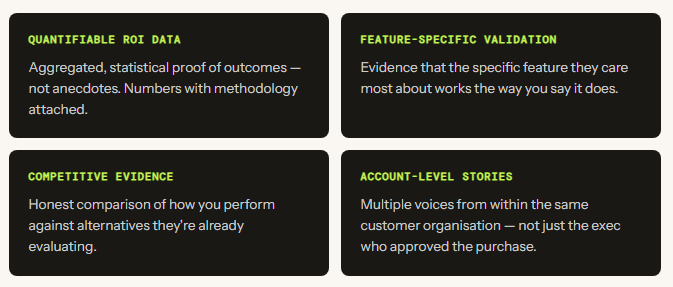
Your buyers want unbiased evidence that they can independently validate. They are no longer swayed by highly varnished customer stories or testimonials. They want to see:
- Aggregated, quantifiable ROI data or statistical proof
- Evidence that a specific feature they care about works the way you say it does
- Honest comparison of how you perform against alternatives they are already evaluating
- Industry Proof Points
- Multiple voices from within the same customer organisation — not just the exec who approved the purchase.
The positioning that wins
The common thread is that your buyers are fundamentally human. They want to feel that other people like them, in organizations like theirs, made this decision and were not burned by it.
You need to sell that on your website, in outreach, on the demo request page, and in the demo itself. Everything that your buyer touches should speak to their specific recurring problem.
This is the essence of B2B SaaS demand generation. Not gated whitepapers or generic “contact us” forms. But a consistent, multi‑channel strategy that makes buyers feel understood before they ever talk to sales.
When you get that right, something shifts. Your buyers stop evaluating you and start feeling understood. And a buyer who feels understood doesn’t need to be convinced — they need to feel safe. Your job is to give them that safety through specificity, relevant evidence, and a demo that speaks directly to their world.
That’s what moves B2B SaaS from interesting to chosen.